Spatial Smoothing with Rust in hySpc.hpc
Source:vignettes/spatial_smoothing.Rmd
spatial_smoothing.RmdIntroduction
Hyperspectral imaging data often suffers from spatial noise. A common
preprocessing step is to apply a spatial smoother. This vignette
demonstrates how to use the graphSmooth() function provided
by hySpc.hpc.
This implementation leverages Rust’s extendr framework
and the high-performance faer linear algebra crate to solve
the sparse Laplacian equation:
Where: * is the identity matrix. * is the graph Laplacian of the spatial grid. * is a smoothing parameter. * is the noisy input hyperspectral data. * is the resulting smoothed data.
Usage
First, load the required packages.
Let’s create a simulated noisy hyperspectral image. We’ll use a small spatial grid and wavelength bands for demonstration.
set.seed(123)
width <- 10
height <- 10
n_pixels <- width * height
n_bands <- 5

# Create a clean signal (e.g. a simple gradient)
clean_signal <- matrix(rep(1:n_pixels, n_bands), nrow = n_pixels) / n_pixels

# Add Gaussian noise
noisy_signal <- clean_signal + matrix(rnorm(n_pixels * n_bands, sd = 0.2), nrow = n_pixels)

# Wrap it in a hyperSpec object
spc_noisy <- new("hyperSpec", spc = noisy_signal)
Applying the Smoother
To apply the smoother, we simply call graphSmooth(),
providing the spatial dimensions.
# Apply smoothing with alpha = 2.0 and 8-connectivity
spc_smoothed <- graphSmooth(spc_noisy, width, height, alpha = 2.0, neighbors = 8)
We can visually compare the noisy and smoothed data.
# Extract the first wavelength band and reshape to a matrix for plotting
noisy_band1 <- matrix(spc_noisy[,,1]@data$spc, nrow = height, ncol = width)
smoothed_band1 <- matrix(spc_smoothed[,,1]@data$spc, nrow = height, ncol = width)

par(mfrow=c(1,2))
image(noisy_band1, main="Noisy Band 1", col=hcl.colors(12, "viridis"))
image(smoothed_band1, main="Smoothed Band 1", col=hcl.colors(12, "viridis"))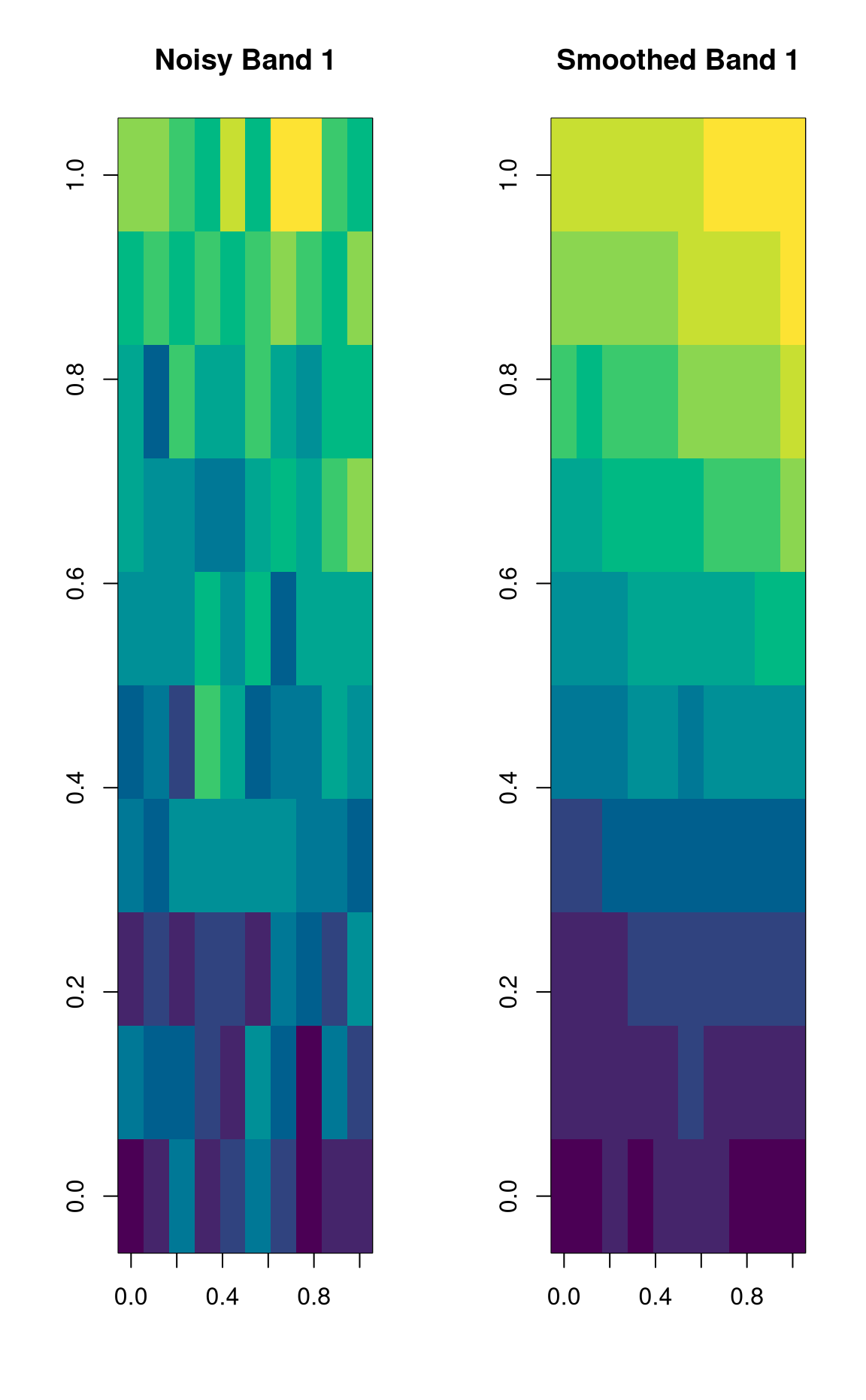
Parameters
-
alpha: Controls the amount of smoothing. Higher values result in stronger smoothing. -
neighbors: The connectivity of the spatial grid. Can be4(up, down, left, right) or8(includes diagonals).
# Stronger smoothing
spc_strong <- graphSmooth(spc_noisy, width, height, alpha = 10.0, neighbors = 8)
strong_band1 <- matrix(spc_strong[,,1]@data$spc, nrow = height, ncol = width)

par(mfrow=c(1,1))
image(strong_band1, main="Strongly Smoothed (alpha = 10.0)", col=hcl.colors(12, "viridis"))
Performance
By utilizing a sparse Cholesky solver natively in Rust,
graphSmooth() is designed to handle very large images
efficiently. Memory overhead is minimized by directly passing memory
slices via extendr.